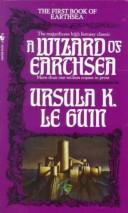

Kelson Reads reviewed A Wizard of Earthsea by Ursula K. Le Guin (The Earthsea Cycle, #1)
To make a light is to cast a shadow
5 stars
I first read the original Earthsea trilogy during my personal "golden age of science-fiction" (i.e. around 12), and I find myself re-reading it about once a decade or so, along with the later novels.
The first book is a coming-of-age story: How a goatherd boy discovered his aptitude for magic, how his pride and arrogance led him astray, how he learned to master his abilities and seek out a way to make up for the terrible evil he unleashed through his recklessness. (Modern readers will probably compare the "boy at a wizard school" aspect to Harry Potter, but that only takes up a couple of chapters.)
It's also to some extent a travelogue of a world with no known continents, only islands, where magic consists of naming someone's or something's true essence, and (more or less) renaming it so as to change it. There's a reason spells are …
I first read the original Earthsea trilogy during my personal "golden age of science-fiction" (i.e. around 12), and I find myself re-reading it about once a decade or so, along with the later novels.
The first book is a coming-of-age story: How a goatherd boy discovered his aptitude for magic, how his pride and arrogance led him astray, how he learned to master his abilities and seek out a way to make up for the terrible evil he unleashed through his recklessness. (Modern readers will probably compare the "boy at a wizard school" aspect to Harry Potter, but that only takes up a couple of chapters.)
It's also to some extent a travelogue of a world with no known continents, only islands, where magic consists of naming someone's or something's true essence, and (more or less) renaming it so as to change it. There's a reason spells are made of words. And it's woven through every part of life, scaling from the simple charms a poor village sorcerer or witch might cast to protect a house from fire, or binding charms to reinforce the joins and seals of a small boat, all the way up to the grand deeds of wizards.
Earthsea feels lived-in, not just a few castles and a bunch of ISO standard medieval villages scattered through the wilderness.
Le Guin never shies away from showing the lives of ordinary people in this world. There's a meme going around about how in Lord of the Rings, Sam is the only member of the Fellowship who isn't at least landed gentry if not aristocracy or royalty (not to mention a literal angel). As mentioned above, Ged starts out as a poor boy (from a poor family), son of a smith who spends his days working the bellows and herding goats. As he travels, he meets sailors, tradesmen and -women, pays for passage on a ship by rowing, and settles for a time in an ordinary fishing village. To be fair, the fishing village does have a dragon problem.
The story and characters hold up well.
I'd forgotten just how much of a jerk Sparrowhawk starts out as, before his harsh lesson in humility sets him on the path to becoming the thoughtful wizard seen in the rest of the series. His school rival Jasper isn't that much worse than he is, and I can read between the lines now as to how they actually get along as friends, especially with Vetch as peacemaker between the two. That he unleashes his shadow while trying to outdo his mirror seems especially appropriate to the story that unfolds.
Part of the purpose of the Roke school is to drum ethics into the heads of people who can literally change reality with a word, along with giving them the knowledge of how to do it effectively. It doesn't always work, and only of a fraction of those with magic ability make it into the school, and some students, like Sparrowhawk, have to learn the lesson the hard way.
I'd also forgotten how briefly Ogion actually appears in the novel. He makes a powerful impression, both on his own terms and as a key figure in Ged's life, despite only appearing for one early chapter and in one scene later on. (We see more of him later on in Tehanu and in the short story "The Bones of the Earth.")
The main flaw in the original trilogy is the misogyny running through Earthsea's culture. Le Guin comes back in Tehanu and the later books and examines how it got there and what effect it has on Earthsea's women (and men). Knowing that it eventually gets challenged mitigates it somewhat, but also makes it stand out more starkly in the books where it's presented at face value.
In the 1960s, the fantasy genre still made certain demographic assumptions, and Le Guin, early in her career, was already pushing things by making the main characters, and most of the population, not be white.
I do appreciate Yarrow, Vetch's sister, who treats the great mage Sparrowhawk so casually because of how well she and her wizard brother get along. Something I noticed on my latest re-read of The Farthest Shore is that she's one of the handful of people to whom Ged eventually entrusts his true name.
Ged's quest at first is to flee his curse, then to make up for it, and finally to pursue it. What he needs to do isn't what you might expect from high fantasy of the 1960s, though it might be exactly what you expect from reading more Le Guin as she continued to explore themes of duality, balance and responsibility throughout her body of work.
The Earthsea books are epic like The Odyssey, not epic like Lord of the Rings. There are dragons, and monsters, and swordsmen and pirate raids, and the occasional wizard's duel. But the big problems aren't solved with great battles. To paraphrase Lorien in Babylon 5, they're the kind of thing you have to understand your way out of.