po3mah reviewed Fahrenheit 451 by Ray Bradbury
why i didn't read it before
5 stars
It's like it was written today. Spoiler: Protect books at all costs.
It's like it was written today. Spoiler: Protect books at all costs.
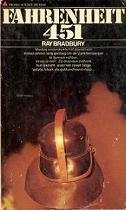
paperback
Published Aug. 26, 1971 by Ballantine Books.
Fahrenheit 451 is a 1953 dystopian novel by American writer Ray Bradbury. Often regarded as one of his best works, the novel presents a future American society where books are outlawed and "firemen" burn any that are found. The book's tagline explains the title as "'the temperature at which book paper catches fire, and burns": the autoignition temperature of paper. The lead character, Guy Montag, is a fireman who becomes disillusioned with his role of censoring literature and destroying knowledge, eventually quitting his job and committing himself to the preservation of literary and cultural writings.
The novel has been the subject of interpretations focusing on the historical role of book burning in suppressing dissenting ideas for change. In a 1956 radio interview, Bradbury said that he wrote Fahrenheit 451 because of his concerns at the time (during the McCarthy era) about the threat of book burning in the United …
Fahrenheit 451 is a 1953 dystopian novel by American writer Ray Bradbury. Often regarded as one of his best works, the novel presents a future American society where books are outlawed and "firemen" burn any that are found. The book's tagline explains the title as "'the temperature at which book paper catches fire, and burns": the autoignition temperature of paper. The lead character, Guy Montag, is a fireman who becomes disillusioned with his role of censoring literature and destroying knowledge, eventually quitting his job and committing himself to the preservation of literary and cultural writings.
The novel has been the subject of interpretations focusing on the historical role of book burning in suppressing dissenting ideas for change. In a 1956 radio interview, Bradbury said that he wrote Fahrenheit 451 because of his concerns at the time (during the McCarthy era) about the threat of book burning in the United States. In later years, he described the book as a commentary on how mass media reduces interest in reading literature.
In 1954, Fahrenheit 451 won the American Academy of Arts and Letters Award in Literature and the Commonwealth Club of California Gold Medal. It later won the Prometheus "Hall of Fame" Award in 1984 and a "Retro" Hugo Award, one of a limited number of Best Novel Retro Hugos ever given, in 2004. Bradbury was honored with a Spoken Word Grammy nomination for his 1976 audiobook version.
Also contained in:
It's like it was written today. Spoiler: Protect books at all costs.
It's like it was written today. Spoiler: Protect books at all costs.
It's like it was written today. Spoiler: Protect books at all costs.
It's like it was written today. Spoiler: Protect books at all costs.
As you're reading this book, it's difficult to remember that it was written in 1951. The technological "predictions" are interesting (bluetooth headphones, reality TV). But I think the most interesting portions are the discussions of the nature of books and media. Toward the end, we get a discussion of people as books (using their innate photographic memories to read/scan books that can later be retrieved from them), but this quotation from Faber around the middle of the book is probably my favorite moment...the texture of books, a texture that can be examined closely, and the rewards of that process of examination.
"Do you know why books such as this are so important? Because they have quality. And what does the word quality mean? To me, it means texture. This book as pores. It has features. This book can go under the microscope. You'd find life under the glass, …
As you're reading this book, it's difficult to remember that it was written in 1951. The technological "predictions" are interesting (bluetooth headphones, reality TV). But I think the most interesting portions are the discussions of the nature of books and media. Toward the end, we get a discussion of people as books (using their innate photographic memories to read/scan books that can later be retrieved from them), but this quotation from Faber around the middle of the book is probably my favorite moment...the texture of books, a texture that can be examined closely, and the rewards of that process of examination.
"Do you know why books such as this are so important? Because they have quality. And what does the word quality mean? To me, it means texture. This book as pores. It has features. This book can go under the microscope. You'd find life under the glass, streaming past in infinite profusion. The more pores, the more truthfully recorded details of life per square inch you can get on a sheet of paper, the more 'literary' you are. That's my definition, anyway. Telling detail. Fresh detail." (79)
Un livre qui n'est pas sans rappeler 1984 de George Orwell, qui dépeint une société ayant basculé vers le totalitarisme, avec là aussi une police de la pensée et une volonté de supprimer le rêve et la libre pensée des personnes.
Qui n'est pas non plus sans rappeler la politique de certains pays qui se disaient démocratiques il y a encore peu. Assez effrayant dans sa vision quand on pense qu'il a été écrit en 1951.
Un roman assez court, à lire ou à relire absolument. Avant qu'il ne soit lui aussi brûlé.
Un livre qui n'est pas sans rappeler 1984 de George Orwell, qui dépeint une société ayant basculé vers le totalitarisme, avec là aussi une police de la pensée et une volonté de supprimer le rêve et la libre pensée des personnes.
Qui n'est pas non plus sans rappeler la politique de certains pays qui se disaient démocratiques il y a encore peu. Assez effrayant dans sa vision quand on pense qu'il a été écrit en 1951.
Un roman assez court, à lire ou à relire absolument. Avant qu'il ne soit lui aussi brûlé.
I had read this book a long time ago and remembered it as a difficult read - my english was not quite on the same level as it is today. When re-reading it now i was blown away. An amazing story paired with wonderful storytelling. After reading "boring" contemporary novels this was delightfully refreshing
I had read this book a long time ago and remembered it as a difficult read - my english was not quite on the same level as it is today. When re-reading it now i was blown away. An amazing story paired with wonderful storytelling. After reading "boring" contemporary novels this was delightfully refreshing
É uma distopia clássica, li há muito tempo mas lembro de não ter achado tão envolvente quanto as primas mais famosas (1984 e Admirável Mundo Novo). Recomendo o conto "Bright Phoenix" que inspirou o livro (é curtinho e achei melhor que o livro).
É uma distopia clássica, li há muito tempo mas lembro de não ter achado tão envolvente quanto as primas mais famosas (1984 e Admirável Mundo Novo). Recomendo o conto "Bright Phoenix" que inspirou o livro (é curtinho e achei melhor que o livro).
There are so many quotes that I have taken away from this book and that I will carry with me for the rest of my life. I think one of the main (or, most impactful) ones is 'if you drown, at least die knowing you were heading for shore' - such a beautiful way of saying die doing what's right. It reminds me of the quote from Stéphane Charbonnier who stated, 'I'd rather die standing than live on my knees' (he was later killed by Islamic terrorists who did not agree with the viewpoints he published). I know that many people reading this review might argue that I should have read this book earlier in my life (and they're likely right) but I want to attempt to rebut this by saying that I think, if I were to read Fahrenheit 451 at any younger age, I might not have been …
There are so many quotes that I have taken away from this book and that I will carry with me for the rest of my life. I think one of the main (or, most impactful) ones is 'if you drown, at least die knowing you were heading for shore' - such a beautiful way of saying die doing what's right. It reminds me of the quote from Stéphane Charbonnier who stated, 'I'd rather die standing than live on my knees' (he was later killed by Islamic terrorists who did not agree with the viewpoints he published). I know that many people reading this review might argue that I should have read this book earlier in my life (and they're likely right) but I want to attempt to rebut this by saying that I think, if I were to read Fahrenheit 451 at any younger age, I might not have been able to take away as much as I did reading it this time. I'm currently 19 years old, though Fahrenheit was actually one of the first books I ever purchased. It had a beautiful animated cover and came along with Brave New World (which had 3D glasses tucked behind the first page so that you could view the cover image from a different perspective); whilst I would have been able to read both books in my youth, I'm somewhat glad I didn't as I worry I might have ruined them, spoilt them for myself. F451 made me feel so electric with every single word, page, and character. With every single location, event, and detail. It took a little time getting used to the writing style but once I was into it, I was completely in. Sidenote, the detail of the vent in Montag's house was wonderfully done and felt so suspenseful.
'Stuff your eyes with wonder.'